Just got back yesterday from my liveaboard trip with Deep Sea Divers Den! The trip was amazing, exhausting, and I would absolutely do it again if I get the chance. The diving was awesome, the food was delicious, and everyone on-board was fantastic.
Let's start with an overview of the Oceanquest, the boat I was on. It's a 36-metre catamaran, and the info site says that the boat has 3 floors, but that's a lie! There is actually a fourth psuedo-floor in the pontoons (that's the floaty long bit at the bottom, think of pontoon boats) where the hostie quarters are. A hostie is (to the best of my knowledge) an Australian word for housekeeper. The job of a hostie is to change beds, clean bathroom, wash dishes, vacuum, etc.
To get to the crew quarters, you go outside on the main deck...
Open the hatch...
Hostie quarters! It's air conditioned and the beds are pretty comfy. There's no
bathroom though, so we had to go to the dive deck to use the toilets and showers.
The boat was roomier than I expected, which was good because it took me a while to get my sea legs and I spent a fair bit of time smashing into walls.
Sitting room on the mid (second) deck. I'm not sure what the theme is supposed to be... but there were lots of pointy masks
on the walls that posed a bumping-into hazard. For me, anyway.
The dining room. Lonneke, another hostie, is probably filling out her dive log.
Sitting area on the wheelhouse (top) deck.
On the wheelhouse deck.
The dive deck.
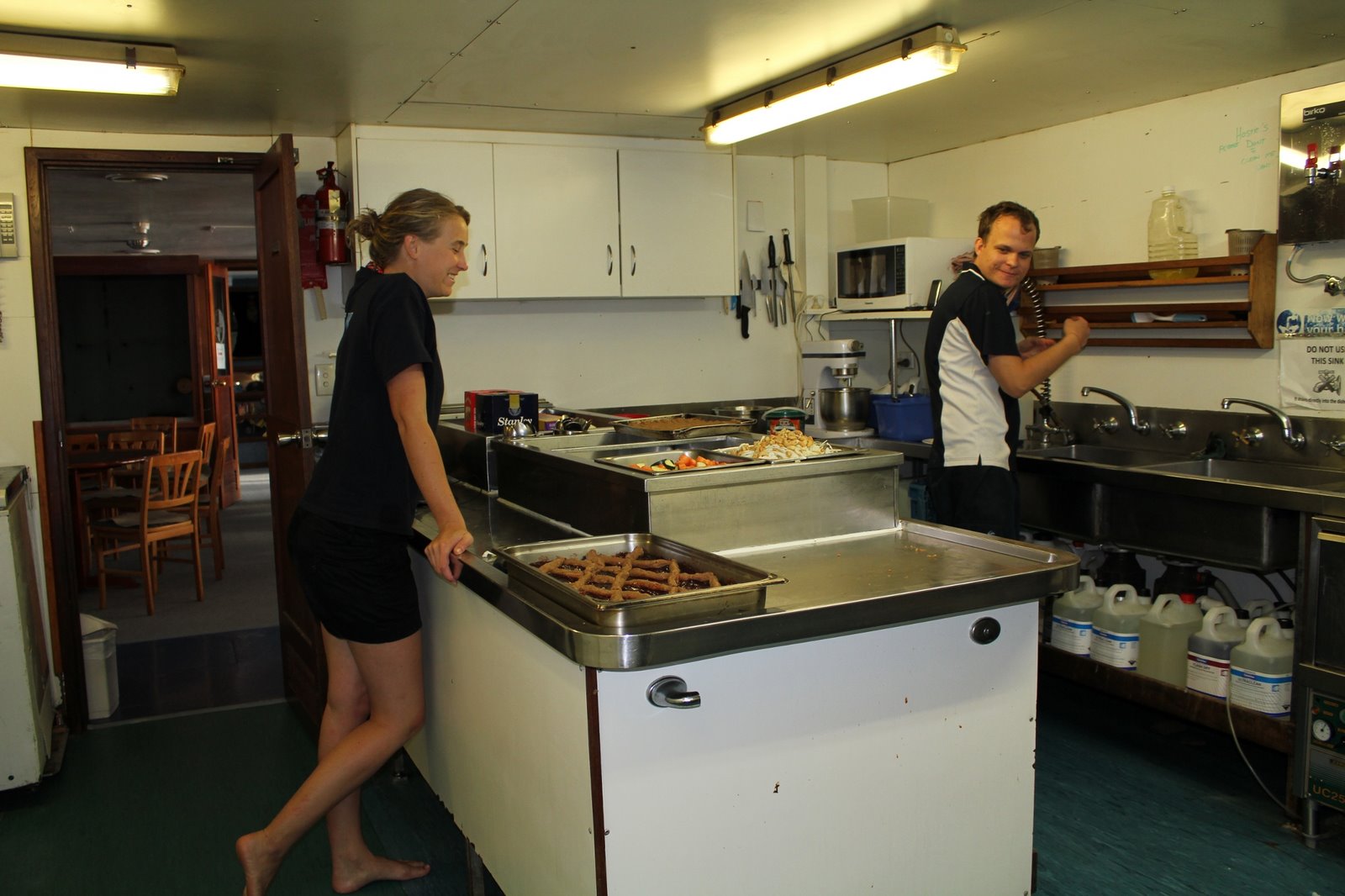
Where I spent a lot of my time: in the kitchen. This is Reuben, the chef on-board for my first few days.
Lonneke and I spent a lot of time eyeing the desserts in here.
I could alternatively call this a cultural immersion experience. The passengers and crew came from all over the world, and I met people from Canada, France, Britain, Germany, Holland, and Japan. Actually, a lot of the passengers and crew were Japanese, including my adorable boss, Nanako-san. If I go back, I will re-learn some Japanese and try to use it more.
The diving was great! I made 15 dives during my 5-day stay, and I took my camera on all but two of those. My camera doesn't take amazing photos, but it's all about the memories, right? :)
Coral.
No idea what fish this is.
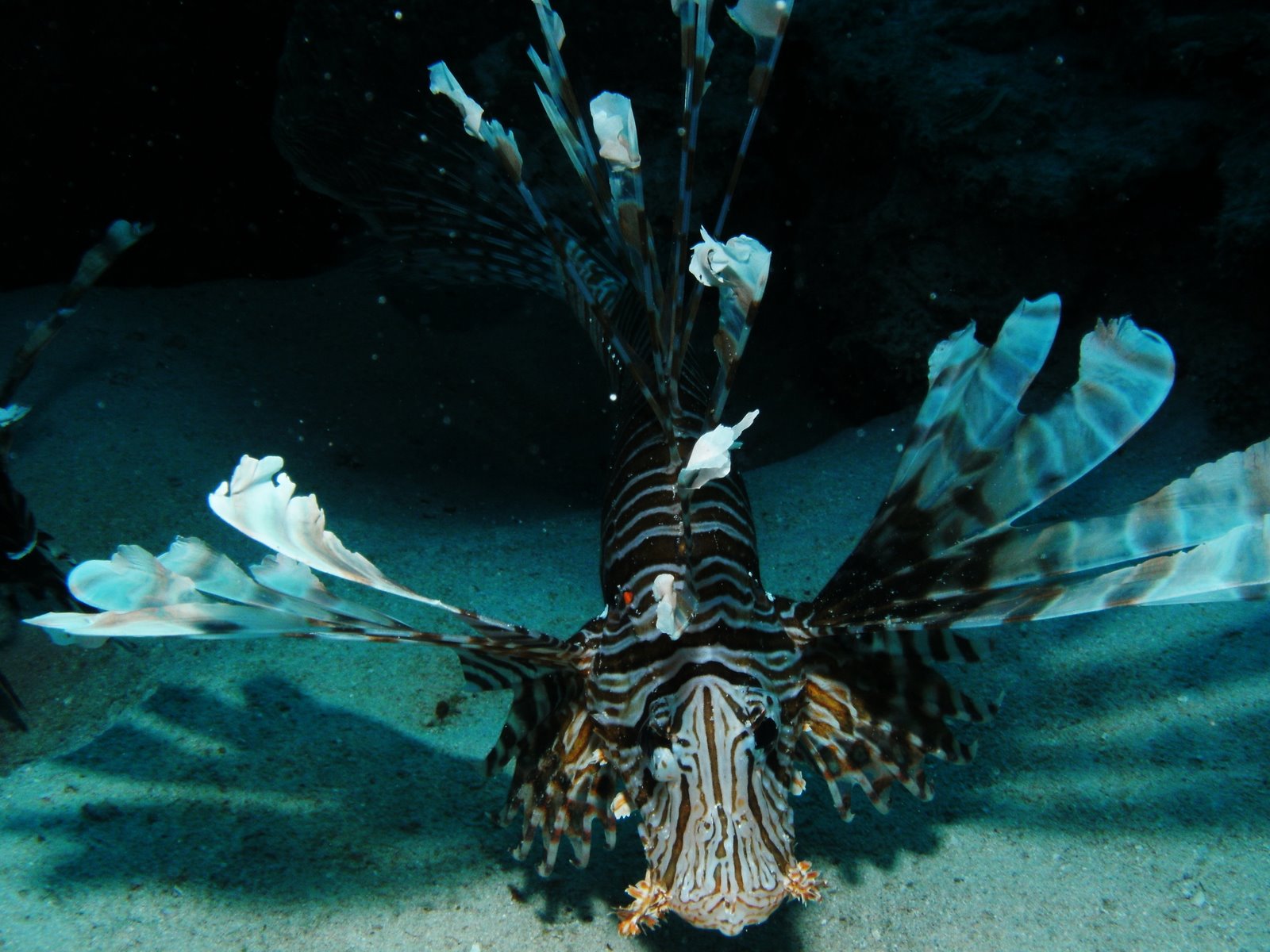
Lionfish! This was just a little one, he was cute.
SHAAAAAARK!
Less dangerous: the sea cucumber. This guy was at least 3 feet long though!
Giant clam, at least two feet long. It's hard to get perspective in these pictures!
Christmas tree worms, with a little fishie.
I believe these are pink anemonefish.
From farther away. This anemone was really big!
Scissor-tail sergeant!
Blue-spotted stingray!
Durban Hinge-Beaked Shrimp!
This is a hermit crab with anemones attaches to him! Cool!
More prawns.
MORE prawns!
It reminds me of tire tracks for some reason...
Lionfish!
Cute fishies!
Green sea turtle!
A butterflyfish and a parrotfish.
Clownfish in a mushroom leather coral!
Napoleon wrasse!
This guy was very large, about 4 feet long. He's got a cleaner fish on him here.
The patterns on these guys are awesome.
They aren't afraid of people, so you can get nice and close to them.
A little white-tip reef shark!
Some type of butterfly fish, with a damselfish on the left.
Melon butterflyfish.
Seriously, sharks are so exciting!
A juvenile Midnight Snapper.
No clue what this guy is! I saw a lot of them, and they're very cute.
From farther away. See the coral on the left? This guy is very small!
No clue what this is!
This is called a Diagonal-Banded Sweetlips.
It's a spotted unicornfish!
More anemonefish. Kinda cute, aren't they?
I have another liveaboard trip booked at the end of the month, and I might do another with Deep Sea Divers Den if I get the chance. The only trouble is that I'll need to take care of my seasickness problem. Does anyone know of any reliable treatments for seasickness? I didn't sleep at all (literally, not even for five minutes) my first night, I was so sick. I got lucky and traded sudafed for sleeping pills, and after that and life got much better, but I want to come better-prepared next time.
That brings me to the three big lessons I've learned from this trip:
1) The quickest and surest cure for seasickness is to get in the water. (Preferably to go diving.)
2) Be prepared for every possible illness you might encounter, especially when you are going to a remote location, such as the ocean.
3) Find out what OTC meds are prescription-only in other countries and bring TONS of it. Sudafed is prescription-only here and my small stockpile of it has proven useful. I'm not encouraging illegal trading of drugs here, but in the event that you need something and can't access a doctor, it's good to have bargaining chips.
More photos and a few videos will be up soon, so check here again tomorrow! :)
In the time it took me to go through all the family-trip photos... well, not a lot has happened, actually. First, the rainy season started. This is not good. It rained for a week and not once in that time did I see sunlight. I HATE the rain and being wet. You may be wondering, then, why I came to the rainforest. I knew there would be rain, but this... this was something new. I have never seen this much water fall from the sky in so little time. It was apparently a record high in 30 years.
The best part? My umbrella broke. And then got stuck in my hair. While I was coming back from class with my laptop. :(
The walkways were flooded, the whole world smelled like wet dog, and I was without an umbrella. I finally forced myself to go down to Smithfield, where I wandered around an industrial complex until I found a store that sold umbrellas. Not that it mattered at that point, because I was already soaked. (Rain makes me cranky, can you tell?)
But enough about the miserable stuff! I'm still volunteering at the aquarium, and now I've got a new thing to do there: feeding jellyfish polyps! One of the grad students is trying to raise an unidentified (and possibly brand spankin' new) species of jellyfish. I come in twice a week to feed them and change their water. It's very peaceful, actually. Jellyfish are relaxing animals.
The white bits with the strings are jellyfish polyps. The tiny orange things are brine shrimp. The orangey polyps
are ones that have already eaten some of the brine shrimp.
Jellyfish have two life stages: polyp and medusa. The polyps are can be floating or sessile, and the ones I'm working with tend to stick to something and stay there. Polyps asexually produce medusa, so there are alternating generations of polyps and medusa. The medusa are the jellyfish you think of normally, with the bell and tentacles. Some jellyfish species don't do the polyp phase and produce fertilised eggs, but most do the polyp-medusa alternation.
And here's a short video of the polyps. If you watch carefully you can see the polyps reaching out and grabbing the brine shrimp, which get stuck in their tentacles and are subsequently eaten.
The only other thing of interest to happen recently was the last session of my Venomous Australian Animals class. It's been my favourite class here and the only one I truly looked forward to attending. I've learned so much about not just venom, but also physiology, first aid, and neuroscience. We finished up the semester with the real story behind Steve Irwin's death.
Our professor was on the boat as the venom expert and was with him when he died. The whole incident was very unlucky, but if I've learned one thing from it: never swim up behind a stingray. Steve Irwin did, and the stingray instinctively snapped its tail and hit him with a barb, which is a miniature barbed spear. The spear went through his heart, and he bled out into his chest cavity within a few minutes. Only three people have ever been known to die from stingrays.
See how it's barbed? It rips like crazy
when you pull this thing out.
Bet you thought that last photo was under a microscope, right? Nope. These
barbs can be huge, and very sharp. They are brutal on flesh.
In the afternoon we had a first aid 'practical,' where we had a 'victim' and had to figure out what happened to her and treat her accordingly. We also got to watch a stonefish being milked for venom! The process involves taking a hypodermic needle and sticking it parallel to the spine into the venom sac, then sucking out the venom into the needle. People often step on stonefish, and they've got a nasty venom that will eat up your foot if you don't get antivenom. I've seen photos of people who thought they could tough it out--not pretty.
Photo courtesy of Monash University.
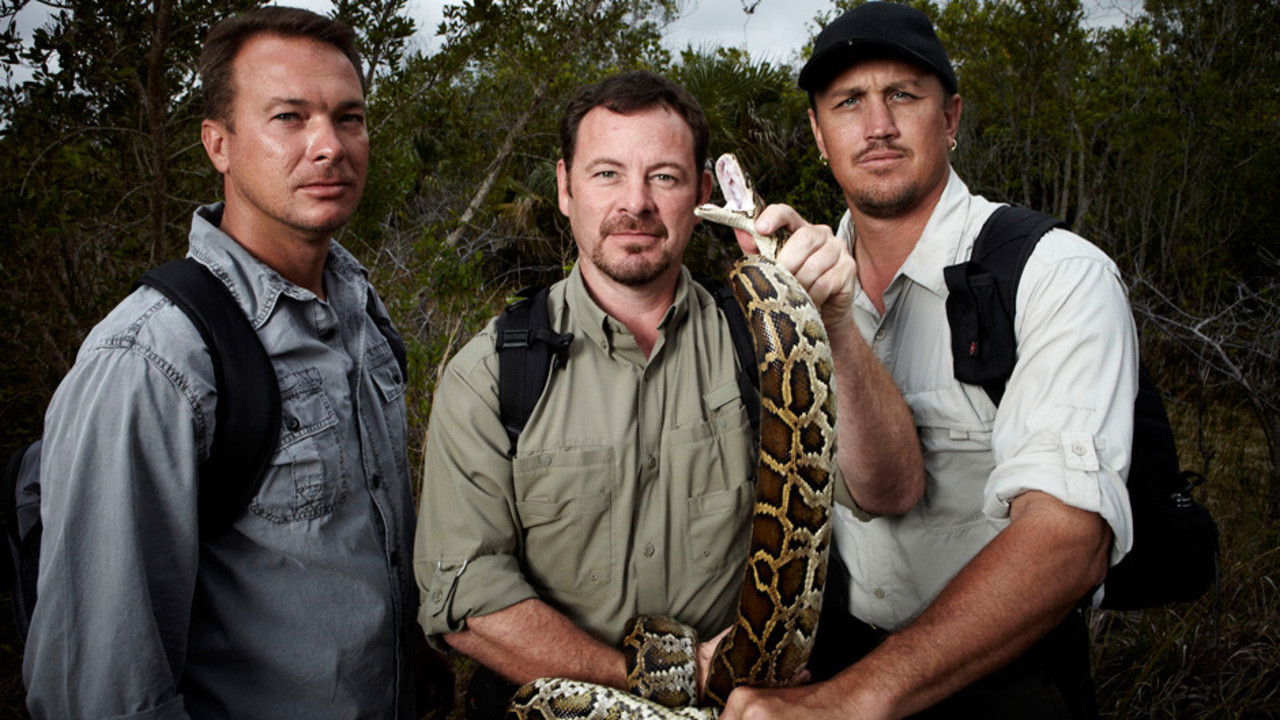
We also had the good fortune to have the hosts of the Nat Geo Wild show "Python Hunters." They were brash, tough American dudes, and they were absolutely great to chat with.
Look at these guys. They look so serious! (They're not.) Photo courtesy of Throng.ca.
From left to right we've got Michael, Shawn, and Greg. Photo courtesy of National Geographic.
These three guys came from different fields, but they're doing what they love--which is apparently snake wrangling. Our class spent a lot of time talking with them about their experiences, and we also got into a heated America-vs-Australia debate about weapons ownership. (The Americans won, by the way. Once the folks here found out that robbers can sue them here, they came around pretty quickly.)
One more bit of exciting news: I'm going on a liveaboard trip on Friday! I signed up to volunteer on a second boat, this time for 5 days. Hopefully it'll be a lot of fun, and I'll update with photos when I get back! :)